Showing posts with label bicycles. Show all posts

Project Update (Residency: Japan Foundation Exchange)


For Japan Foundation Exchange Residency in collaboration with Makoto Nomura, I composed 2 6mins soundscape pieces.


“Fieldwork”(Yraola, 2021)

Fieldwork is a composite of audio recordings gathered during research and educational trips in 2019. The work mostly contain voices of resource people, of the researchers, and people who are just observing the proceedings. The voices is altered by sound of wind, walking, and motorised public vehicles (tricycle and jeep).

The composition attempts to capture the feeling of being outside, on the street, in the Philippines.


“Homestretch”(Yraola, 2021)

Homestretch combines several recordings done during my last few months in Hong Kong, after 5 years residence there, right before I moved back in Manila. I settled home just a few weeks shy of the first community lockdown due to Covid Pandemic.


Among the sounds capture and used in this work were: the last seminar I attended; an electrostatic sound that is captured every time a text message is received on the phone beside the recorder; the sound of cicadas; birds; and strong wind that were recorded in my university campus in Hong Kong.


While the recordings were done in Hong Kong, these composite of sounds became relevant to me and my coming home to Manila, as it was abruptly replaced by unfamiliar silence—not one without sound, but one with the feeling of lull, bewildering, but not entirely unpleasant.


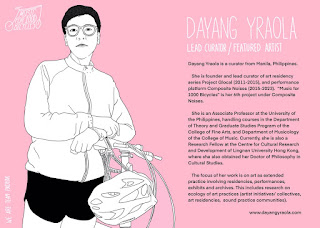
Dayang Yraola

Manila, Philippines

December 2021


In response, I made 4 tracks of 6 and 6.5mins each that should be listened to in combination.


The track1 is my piano playing in tune with insect singing.


The track2 is my melodica playing in high register in tune with piano chords.


The track3 is the field recording, which I recorded in Kyoto. The intense pulse by an autumn ringing Japanese insect. 


The track4 is from my workshop entirely playing ceramic roof tiles in Okinawa. We played roof tiles outdoor. There are some wind noises as well, but I am sure this recording fits 1000 Bicycles.


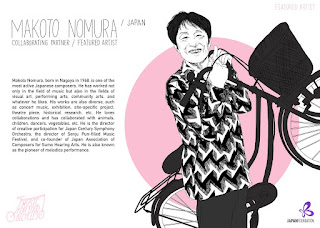
Makoto Nomura

Kumamoto, Japan

December 2021


During the residency, both artists were also working on many other projects. This perhaps is the key for revising the original intention to just “exchange sounds” of Japan and Philippines. It became more evident  that our auditory experience is beyond the physical perception of the sound. It has everything to do with our experience.  This experience is not singular and isolated, but a constellation of many experiences. In other words, the feeling of connectedness became more pronounced. This is the main reason why Dayang later tapped into her recordings from when she was in Hong Kong—having realized that the absurd and abrupt quiet of Manila during the pandemic was juxtaposed to the noise of her last months of residence in Hong Kong (besides the fact that Makoto and she both lived in Hong Kong at one point); and for Makoto to respond to Dayang’s work instead of starting a composition exclusively about and from Japan.


The opportunity that Japan Foundation provided for the artists through this residency, to be able to connect, is immeasurable, especially at the time when connections felt severed. Makoto and Dayang are among the friendships that Japan Foundation seeded in their past project (Media Art Kitchen, 2012-2013), and it is a friendship that remains productive.


This residency is supported by 

 

This residency does not cover staging of the compositions. Updates and our other activities are posted on  Facebook and Instagram under the account Music for 1000 Bicycles

Project Update (Residency: Goethe Institut Virtualles Musikproject)

 
For the Goethe Institut Virtuelles Musikproject in collaboration with TinTin Patrone, I composed 2 6mins soundscape pieces.

“ECQ BDA” (Yraola, 2021)
After living in Hong Kong for 5 years, I move back home to Manila in 2020. I have just received the last of my moving boxes from Hong Kong just a week shy of the first lockdown due to the Covid pandemic in March.

I was locked in my family home—a 40-year-old house surrounded by a lush garden, walled and gated but just a few metres away from the expressway. The auditory experience on the first day of the lockdown was surreal, as the constant presence of machine sounds, suddenly stopped—abruptly, not gradually. This quiet persisted for many months, until we are more used to hearing the birds, and even a small lizard. As the lockdown eases up, so do the machine sounds return. But somehow it did not sound like the way they did before.

This work is a composite of audio recording inside the residential property between March 2020 to November 2020, and this is how my homecoming. ECQ BDA stands for Enhanced Community Quarantine: Before, During and After. 


(1) This video was taken via CCTV on the evening before the implementation of the lockdown in March; there were street repairs that were happening on the expressway few metres away from our compound.

(2) This video was taken from the front lawn of our house, as I was recording during the lockdown.

(3) This video was taken the day after the first lockdown was lifted. There were 3 hospitals near my area, the silence is usually punctuated with ambulance sirens, as if reminding us that the pandemic is not yet over.

"Twitter" (Yraola, 2021)
Twitter, the social media app, is something we listen to. We have made it a “voice” relevant to our lives. Every tweet, a reaction. This is what I am exploring in composing the sound work “Twitter”. It is a composite of actual bird sounds collected from my family home during the pandemic lockdown and electronic bird sounds that I made in my computer. In bringing these twitters to our bike ride, I am interested to find out whether people would have the same compulsion to pay attention every time there is a tweet, as they do in the social media app; and ultimately how this attempt to call-attention via audition from and for moving bodies will translate into connectedness (no matter how temporary).

The compositions I made for this virtual residency are works that attempts to bring the sound of Manila (or a portion of it) to Germany—to my collaborative partner, TinTin, which she can use as reference in composing her work that brings together her own auditory experience when she visited Manila in 2019, how it had been lately vis-à-vis her present place of residence. 
 
(4) This video of “Twitter” in preparation for its usage for the performance “Music for 1000 Bicycles”

Dayang Yraola
Manila, Philippines
December 2021


In response, I made a 2mins composition, titled “100 Bikes”.

My contribution to “1000 Bicycles” is mainly based on sounds and samples of the Filipino mainstream techno genre called ‘Budots’. After close discussions with Dayang Yraola, the framework for sound and subsequent performance was determined. Audio and visual elements should be related to the Filipino background of the original concept as much as possible. For my part, the focus fell on current urban music trends in the Philippines. These are intended to represent a special contrast to the field recording-based audio material by Dayang Yraola and thus reflect a state of lived reality and the imposed renunciation of certain types of music consumption.

Another influence on the compositional decisions mentioned were sound related memories of my last visits to the Philippines., above all, the loudspeakers in public transportation vehicles that are present everywhere and turned up in volume, bawling out material from every music genre between pop, rock and techno to keep guests and ferries entertained and awake.

The attached sound file only represents a selection of the Budots samples and field recordings from Manila. The final composition cannot be created as a recording in advance, as the performance also includes random components. In the summer of 2022, 100 bicycles are to move around in a parking garage on different levels, each of them will start in different teams and different loops with different sound categories (drums, effects, voice samples, etc.). This creates a loop that is constantly changing and enabling different perceptual experiences depending on the position of listeners.

TinTin Patrone
Hamburg, Germany
December 2021


This residency is supported by 


This residency does not cover staging of the compositions. Updates and our other activities are posted on  Facebook and Instagram under the account Music for 1000 Bicycles

Project Update


Music for 1000 Bicycles grew and had taken a different shape from when it was released earlier in June. This blog is an update after we posted an invitation possible collaborative partners in May on our Facebook page


At the moment there are 6 legs: Hamburg (Germany), Japan, San Francisco (USA), University of the Philippines, Diliman/Baguio/Ilolilo (Philippines).  

Few details (parameters) of the collab are:

1. The audio work that is going to be produced has to be inspired by outdoors sound experience that are moving (rainfall, flock of birds, traffic, train, etc). This is an attempt to amplify the outdoor sounds; sounds that became too distant or too rare to us when pandemic lockdowns started. 

2. There has to be an identified route or site that will be the basis of the composition. Since this is an outdoor performance, the sound within the site of performance has to be considered by the composer. This site will be the basis of the choreography of the moving bodies (bike riders). And this identified site will make video and sound captures for documentation easier to manage.

 3. It is possible that the composition, choreography, and performance will considered 3 different phases.  

 4. There will be rehearsal rides, where only proponents (and a small number of invited friends) can participate. The purpose of rehearsal rides is to test the composition and choreography in situ, which will give the artists spatial insight necessary to improve their work. Tentative schedule: September 2021-February 2022.

5. There will be test rides (small group; max 30) and performance rides (big group; min 31) between March 2022- February 2023.

 6. A documentary video featuring all rides (including rehearsals) is scheduled to be be released in May 2023.

 Email dyraola@gmail.com for complete Project Information.


by Anjo Bolarda


Music for 1000 Bicycles-Hamburg is from the original collaboration with TinTin Patrone (blogs below), as part of our residency with Goethe Institut.  

TinTin and I are currently surveying our individual and shared sound banks (physical and conceptual) while we get ready to determine the story we wanted to tell in our Hamburg rides. 

On the sideline, while our residency is only focused on producing the music for the project, we have already invited other artists to consider joining our team for the possible staging next year. Some have already committed. We will introduce them in the coming project updates. 


Music for 1000 Bicycles-Japan takes the same form of the one for Hamburg. I will be working on an exchange residency with a good friend and composer, Makoto Nomura. 


Makoto will be working on a composition using outdoor sound of Japan with an intention of performance in the Philippines. I, on the other hand, will produce a composition using outdoor sound of the Philippines with an intention of performance in Japan. This way, despite the (still) strong restriction for travel, Makoto and I, and our audience will have an opportunity to travel by ear.

We are also exploring possible partners and support for staging the performance. Makoto and I agreed that we will use Japan in the project instead of a particular city (e.g. Kyoto, which was my original plan), to allow possibility of doing this in different cities in Japan. We hope to introduce them in the coming project updates.

This collaborative virtual residency is supported by the Japan Foundation Manila. 


Music for 1000 Bicycles- San Francisco is a partnership with artists Johanna Poethig, Mike Arcega and composer Chris Brown. The production strategy for this leg is still being studied. But their commitment is solid. 

The group already did a trial ride in June, which is most helpful for all of us, as it is now being used as reference in imagining our future performances. 

 
video courtesy of Johanna Poethig


Music for 1000 Bicycles- U.P., Diliman/Baguio/Iloilo is an inter-college and inter-CU (constituent university). It involves faculty members from the Art Cluster of U.P. Diliman, namely, Dr. Maria Christine Muyco from College of Music, Prof. Mona Adviento-Maghanoy from College of Human Kinetics, Prof. Rob Rownd of College of Mass Communication/ UP Film Institute, Prof. Riza Romero and myself from College of Fine Arts. From U.P. Baguio, we are partnered with Prof. Fara Manuel of College of Arts and Communication. And from U.P. Iloilo, we are partnered with Prof. Early Sol Gadong and Prof. Hermie Cartagena of College of Arts and Sciences.


UP Proponents (composite screenshot)


This leg is being prepared to include all phases of production from compositions, choreography, performance and production of documentation.  We are also partnering with local artists, allied organisations and local government units to ensure a more efficient implementation and to maximise the potential of Music for 1000 Bicycles as a community project. We will introduce them in the coming project update.   


A Central Curatorial Team is also formed for the project comprised of Christine Muyco as Lead for Sound/ Music Compositions, Riza Romero as Lead for Video Documentation, Aji Manalo as Lead for  Sound Documentation, Anjo Bolarda as Lead for Visual Direction, Sol Maris Trinidad as Manager for Finance and Administration, and myself as Curator. 


Curatorial Team (composite screenshot)

Collaboration Cycle #1. Day0

10May2021. 3PM in Manila. 9AM in Hamburg. TinTin and I met via Skype to plot our route before we set on this journey with 1000 Bicycles. We've decided to focus on 100 bicycles first and open the rest to other possible collaborative partners for other collaboration cycles, until it all adds up to 1000. We also agreed that the other collaborative partners would be able to make the Pinoy or at least a Manila connection, as conceptual anchor and/or inspiration in attending to the project.  In TinTin's case, she is to begin with a Filipino-German. She also did her research in Manila in 2019. TinTin talks about pedicabs, tricycle, jeepney, buses, taxis, and other transportation that shapes the cityscape of Manila prior to the pandemic--carmageddon, that was how it was called. These Philippine connections will inspire the work for Collaboration Cycle #1.

We'll post a call for collaborative partners in the coming days. Meantime, we brew our thoughts, in preparation for our studio work.
 

Music for 1000 Bicycles

(After Maceda) Music for 1000 Bicycles is a performative installation or a mobile sound sculpture. The collaborating artists will produce music and or sound works that will be uploaded on mobile digital music players. These music players and speakers will be fitted on bicycles.  They will also produce performance instructions that the bikers will follow. This is imagine to produce at the most a 1hr performance, ideally on an outdoor location, like a park.


This work is inspired by Jose Maceda’s composition Music for 1000 Automobiles in the Freeway, which he proposed in 1968. His idea was to produce music on cassette and have them mounted on cars that will run along an American freeway. He called it “gigantic structure of sound or a sound-machine”. The proposal can be found at the University of the Philippines Center for Ethnomusicology. As per records, it appears that this proposal was not actualized in his lifetime. 


image courtesy of UPCE


Music for 1000 Bicycles is similar to Maceda’s work in a sense that the music will be delivered using moving vehicle. It is significantly different however, as the conception of this project is triggered by the extended lockdown that was experienced in 2020. Particularly, Manila had the longest lockdown in all Asian countries. When the mobility in the City was loosen, only minimal public transportation was allowed. People resorted to using bicycle until the time of writing this proposal. Although there had been bikers in the City before the pandemic, their numbers recognisably significantly grew. The City administrators now even seriously heeded the clamour for bicycle lanes. This did not only changed the cityscape, it also significantly affected the soundscape of the city. This is a tribute work—not only to Maceda’s genius, but also and most importantly, it is a work celebrating the resiliency of human spirit and its ability to embrace the ever changing world. 


photo courtesy of Issay Rodriguez